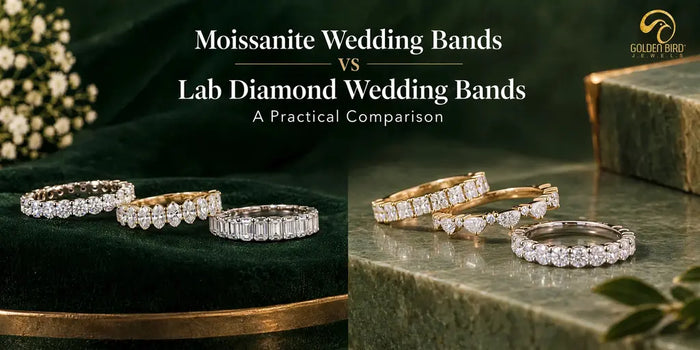
Moissanite vs Lab-Grown Diamond Wedding Rings: A Practical Guide for Couples in Munich

Two Good Stones, One Honest Question
Munich couples shopping for wedding rings in 2026 are landing on the same shortlist: moissanite or a lab-grown diamond. Both are grown in controlled laboratory conditions, both skip the ethical baggage of mined stones, and both look striking set in gold or platinum. The decision that separates them is more granular than most comparison articles admit — it comes down to how you weight price per carat, the type of sparkle you want on your finger every day, whether you need a formal grading certificate, and what the Munich market itself actually charges.
Those four factors pull in different directions. Moissanite wins on price by a wide margin. Lab-grown diamonds win on certification infrastructure and the kind of white-light brilliance that reads as conventional diamond sparkle. Understanding where each stone earns its place makes the decision considerably easier.
Price: What the Numbers Actually Look Like in 2026
Moissanite costs approximately 50–70% less than lab-grown diamonds of equivalent size and quality. Translated into figures that Munich shoppers can work with: a high-quality 1-carat moissanite typically costs between $300 and $600, while a comparable lab-grown diamond ranges from $800 to $1,500. In euro terms, Munich and Frankfurt retailers price certified lab-grown diamond engagement rings at roughly €3,000–€3,800 for a 1.00ct stone, emphasising environmental credentials and IGI certification.
The gap widens as carat weight increases. A 2-carat moissanite rarely exceeds $800, while a 2-carat lab-grown diamond of comparable grade can run €4,000–€6,000 through Munich-area retailers. That spread is large enough to cover the wedding catering, or a honeymoon flight from Munich Airport.
One pricing dynamic worth understanding: improvements in production efficiency have caused lab-grown diamond prices to decline steadily, though the rate of decline has slowed in 2026. Moissanite pricing, by contrast, grows faster, yields more usable material, and operates outside the diamond grading system — which keeps pricing transparent and relatively stable.
For couples with a fixed budget who want the largest possible stone, moissanite delivers more visual presence per euro. For couples who want a stone graded and documented within the established diamond ecosystem, the lab-grown diamond premium probably feels justified.
Sparkle, Colour, and What You Actually See on Your Hand
The optical difference between the two stones is real and measurable. Lab-grown diamonds have a refractive index of 2.42, identical to natural diamonds, while moissanite clocks in at 2.65–2.69 — a higher number that means moissanite bends light more dramatically. The practical result: moissanite has a dispersion value of 0.104 compared to diamond’s 0.044, producing approximately 2.5 times more ‘fire’ — those rainbow-coloured flashes.
Whether that fire reads as spectacular or as slightly busy depends entirely on individual taste and lighting context. Moissanite dazzles outdoors or under bright store lighting, but can appear overly intense in certain environments — like a candlelit restaurant — where lab diamonds provide consistent, sophisticated sparkle regardless of where you are.
Colour grading is also handled differently. Lab diamonds are available in a range of colour grades from D (most colourless) to Z, while moissanite may exhibit a warm undertone under certain lighting conditions, particularly in larger stones — though premium moissanite options are engineered to appear colourless. For a 1-carat stone in a solitaire setting, most people won’t detect any warmth. In a 3-carat oval under direct sunlight, the difference may be visible to a trained eye.
The takeaway: moissanite has its own distinct optical identity — more fire, slightly different colour behaviour. Lab-grown diamonds replicate the optical profile of natural diamonds precisely. Neither is objectively superior; they are genuinely different stones.
Durability Over Decades of Daily Wear
A wedding ring worn every day accumulates real stress — hand washing, gym sessions, kitchen work, the friction of everyday life in Munich’s winters. Both stones handle this well.
Moissanite ranks 9.25 on the Mohs scale of hardness, just below diamonds, which makes it suitable for everyday wear. Lab-grown diamonds rank 10 on the Mohs hardness scale, making them extremely scratch-resistant, while moissanite comes in at 9.25–9.5 — a minimal difference in hardness that means both stones will resist scratching through decades of wear.
There is one area where moissanite arguably has the edge. Unlike diamonds, which have a cleavage plane along which they can split, moissanite does not have such planes, making it less prone to chipping and breaking under impact. For anyone who works with their hands — a surgeon, a chef, a carpenter — that toughness difference is worth knowing.
On the question of long-term appearance: moissanite is non-porous and chemically stable, so it does not absorb oils or moisture — any dullness over time is typically a removable film on the surface from oils, soap residue, or hard-water minerals, not a change within the crystal. Customers report stones that are still flawless after five years of daily wear, with some wearers confirming their moissanite looks just as good after more than a decade.
Lab-grown diamonds behave identically to natural diamonds under wear conditions — the same hardness, the same resistance to scratching, the same need for periodic cleaning. The setting metal (gold prongs, platinum bezels) will require more attention over time than either stone.
Certification: Why It Matters More in Germany
The German market prioritises transparency over aggressive discounting. That cultural preference has a direct implication for ring buyers: certification is not just a nice-to-have in Germany — it is the standard expectation, and it affects insurance valuation, resale documentation, and the confidence of jewellers who might resize or repair the ring years later.
Lab-grown diamonds fit neatly into this framework. IGI certification is an independent grading report issued by the International Gemological Institute that documents the exact cut, colour, clarity, and carat weight of a diamond — including lab-grown diamonds — using standardised laboratory conditions and equipment. IGI operates in over 20 countries, making its certificates widely accepted by retailers and consumers. A certified diamond holds better resale and insurance value, as it comes with verified documentation.
Moissanite sits outside this certification infrastructure. The stone is not graded by IGI or GIA in the same way — there is no standardised 4C report for moissanite, and most jewellers in Germany will not issue an insurance appraisal for it in the same terms as they would for a certified diamond. For couples who intend to insure the ring as a named item on their Hausratversicherung (household contents insurance), or who want the documentation that comes with a formal grading report, the lab-grown diamond has a practical advantage that has nothing to do with aesthetics.
That said, reputable moissanite sellers do issue their own quality certificates, and the stone’s properties are consistent enough that an independent appraiser can assess it. The difference is that lab-grown diamond certification is standardised and globally portable in a way that moissanite documentation currently is not.
Long-Term Value and the Resale Question
Neither stone should be purchased as a financial investment. Neither moissanite nor lab-grown diamonds should be viewed as financial investments — their value is emotional and aesthetic rather than resale-driven. With that established, there is a practical difference worth noting.
Lab-grown diamonds resell for 10–40%, declining as production costs fall. Moissanite’s secondary market is thinner — most jewellers won’t buy back moissanite, and there’s no meaningful upgrade path. For most couples, this distinction is academic: most couples never resell engagement rings, so the practical difference between moissanite’s near-zero and a lab-grown diamond’s limited resale often never materialises.
One development that Munich-based buyers should be aware of: in March 2026, Charles & Colvard — the original creator and largest manufacturer of gem-quality moissanite — filed for Chapter 11 bankruptcy, with revenue having dropped from $43 million in 2022 to just $16 million in 2025. According to the company’s own court filings, falling lab-grown diamond prices made moissanite harder to sell — when lab-grown diamonds cost five times more than moissanite, the value proposition was clear, but now that the gap has shrunk to roughly two times, many buyers who would have chosen moissanite are choosing lab-grown diamonds instead. This does not mean moissanite is a poor choice — the stone’s physical properties are unchanged — but it does mean that sourcing from established, reputable retailers matters more than it did two years ago.
Ordering from Outside Germany: What Munich Couples Should Check
Most Munich couples buying moissanite or lab-grown diamond wedding rings in 2026 are ordering online from international retailers, since local Munich jewellers — including handcrafted studios like RYIA — tend to specialise in lab-grown diamonds rather than moissanite. Cross-border purchases from UK or US-based retailers require a few practical checks.
First, VAT and import duties. Orders from outside the EU are subject to German import VAT (currently 19%) and potentially customs duty on jewellery, depending on declared value and country of origin. Retailers based within the EU ship duty-free to Germany. Second, returns and consumer rights: under German consumer law (Fernabsatzgesetz), you have 14 days to return most online purchases — but custom or personalised orders are typically excluded, which covers most made-to-order wedding rings.
For couples who want handcrafted moissanite or lab-grown diamond rings shipped internationally, Golden Bird Jewels offers both stone types in a range of settings — solitaire, halo, three-stone, and bridal sets — with custom design options. Their lab-grown diamond engagement rings include IGI and GIA certified stones, which satisfies the documentation requirements that German insurers and jewellers expect. For couples drawn to moissanite’s fire at a lower price point, their moissanite engagement ring collection spans the same setting styles in matching metals, making it practical to compare both options side by side before committing.
Which Stone Fits Your Situation
The honest answer is that the right choice depends on three things that only you know: your budget, your preference for sparkle character, and how much the certification ecosystem matters to you practically.
If your ring budget in euros is under €1,500 and you want a centre stone of 1.5 carats or larger, moissanite is the only option that delivers that combination without compromise. The stone will last as long as a diamond, the fire is spectacular, and the ethical credentials are identical. The trade-off is that you are buying outside the standard diamond grading system, which matters for insurance documentation and resale in Germany.
If your budget stretches to €2,500–€4,000 for a 1-carat stone, a lab-grown diamond gives you an IGI-certified ring graded on the same 4C scale used globally, with the optical profile of a natural diamond and the documented quality assurance that German consumers tend to expect. The German lab-grown diamond market reached a volume of 1.6 billion euros in 2024, with annual growth standing at 12.8% — that market scale means local jewellers, insurers, and resellers are increasingly familiar with these stones in a way they are not yet with moissanite.
Some couples find the decision resolves itself the moment they see both stones in person. Moissanite’s rainbow fire either reads as electric or as too much; lab-grown diamond sparkle either reads as elegant or as understated. If you can view samples before ordering — even photographs or video under natural light — that test tends to be more decisive than any specification comparison.